In early May, the news of Doubao launching a paid subscription sparked widespread attention; on May 11, Qianwen fully integrated with Taobao, becoming a focal point in the industry. Together, these developments signal a clear trend: ByteDance and Alibaba are accelerating the commercialization of AI assistants, each advancing along distinct business paths.
Tencent’s Yuanbao, however, is taking a noticeably different approach. Instead of rushing to establish transaction links or experimenting with tiered payments, it continues to deepen its integration within the WeChat ecosystem.
On May 13, Yuanbao launched a group chat summary feature, coinciding with Tencent’s quarterly financial report release.
The timing of these announcements seems intentional. With the recent enhancements in its capabilities and ongoing integration with WeChat, Yuanbao, having fallen out of the top three in the industry, is building momentum for a new phase.
Moreover, Tencent’s confidence in its AI strategy stems from the fact that Yuanbao is no longer its sole ace in the hole. The overall AI strategy of the group is becoming increasingly clear, with a collaborative approach taking shape.
Group Chat Summaries Available, but Requires Forwarding to Yuanbao App
Yuanbao users have long awaited the ability to summarize group chats. Community feedback often includes requests like, “Can you summarize 99+ messages directly in WeChat?” On May 13, Tencent’s official WeChat account announced that Yuanbao now supports summarizing group chat records. The development team quickly rolled out this feature.

Tracing Yuanbao’s integration into the WeChat ecosystem reveals a clear path of gradual penetration and limited authorization: initially, Yuanbao could only be accessed through WeChat’s search feature; by the second half of 2025, WeChat opened friend-adding permissions, allowing users to add Yuanbao to their contacts; in September 2025, Yuanbao entered public accounts and video account comment sections, requiring only a manual @ to summon.
The launch of the group chat summary function not only opens a critical interface for Yuanbao within WeChat but also marks the first time Yuanbao can engage with real-time communication content. Previously, Yuanbao’s presence in WeChat relied on users actively invoking it; now, it can directly process group chat records, integrating into users’ daily information flow. The specific operation involves long-pressing messages to select multiple, checking chat records, and forwarding them to Yuanbao, which then begins summarization.
Tencent’s announcement creatively outlined various use cases: no need to sift through 99+ messages, generating reimbursement forms with one click, customizing travel guides based on group chat needs, and even analyzing chats with a crush to provide “extreme pull” suggestions.
However, user reactions tempered this enthusiasm—“Good news: group chats can be summarized with one click. Bad news: you have to forward it to the Yuanbao App.” Many users expressed disappointment, desiring an assistant that could actively serve within WeChat rather than requiring manual forwarding.
Yuanbao’s official response in the comments was candid: “The current forwarding mechanism is intentionally designed as ‘you actively seek me’ to ensure every interaction is authorized by you.”
This passive activation logic is a deliberate maintenance of WeChat’s moat and serves as a passport for Yuanbao to deepen its integration within the WeChat ecosystem. WeChat’s core asset is trust; if users perceive that chat records are being automatically read or used for training, this moat could be compromised. This is not a retreat in functionality but rather a prerequisite for Yuanbao to advance further within the WeChat ecosystem—maintaining privacy boundaries to gain deeper integration space.
The “red envelope link ban” incident during the Spring Festival proved this point. Yuanbao invested 1 billion in red envelopes, leading to a peak of 114 million MAU, but just four days later, WeChat’s security center banned Yuanbao’s red envelope sharing links for “inducing users to share links frequently and disrupting platform ecology”—even a sibling company was treated according to the rules.
Forcing a breakout is not feasible; instead, the “following the rules and slow penetration” approach has allowed Yuanbao to establish a foothold in the WeChat ecosystem.
Falling Out of the Top Three, but Yuanbao Remains in the Game
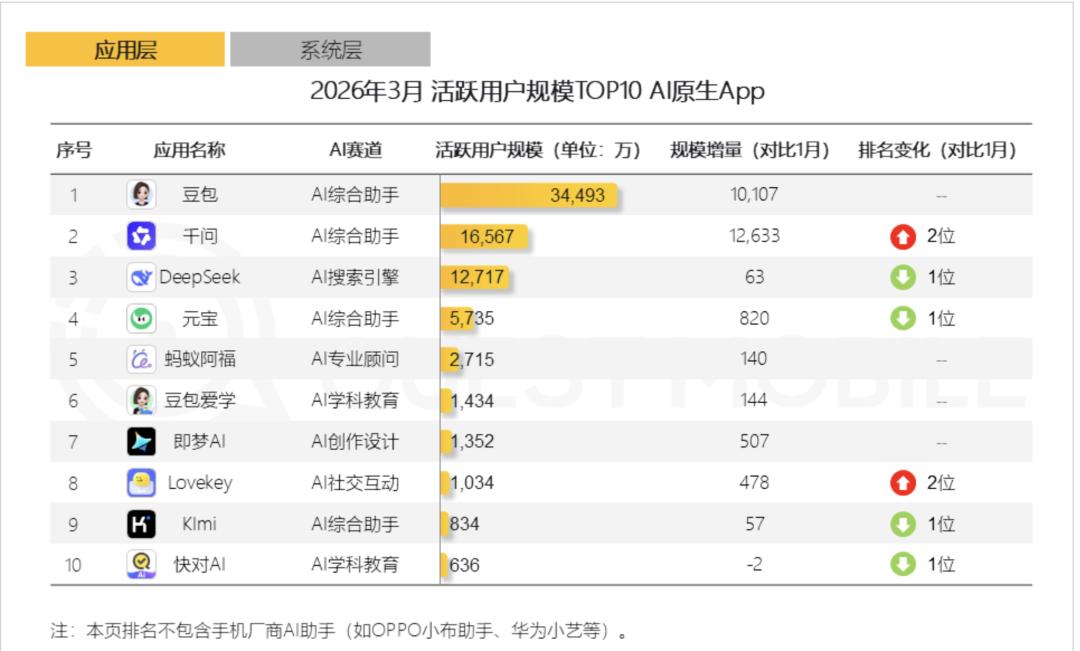
According to QuestMobile’s April report on the “Quarterly Monitoring of China’s AI Native Application Market,” as of March 2026, Doubao, Qianwen, and DeepSeek had MAUs of 345 million, 166 million, and 127 million, respectively, firmly occupying the top three spots. Yuanbao’s MAU stands at 57.35 million, with the red envelope battle’s new user acquisition effect nearly zero—post-holiday DAU quickly dropped to 9 million, with a quarterly user increase of 8.2 million, far behind Qianwen’s 126 million.
In March, Yuanbao attempted to enhance brand recognition by changing its logo: the original green Taiji symbol was updated with anthropomorphic big eyes, and the brand name was simplified from “Tencent Yuanbao” to “Yuanbao.” Officially, this was described as a shift from an efficiency tool to a warm, intelligent partner. User feedback indicated that this change had limited impact on brand recognition.
Yuanbao’s high expectations during the Spring Festival did not sustain momentum post-holiday; attempts to integrate with frameworks like OpenClaw and Hermes also failed to generate lasting buzz.
If one only considers the above information, it is easy to conclude that “Yuanbao has fallen behind.” However, this coordinate system does not accurately reflect Yuanbao’s true situation.
Tencent’s internal positioning of Yuanbao has never been about “defeating Doubao.” In September 2025, Tang Daosheng clarified Yuanbao’s strategic direction in a public interview—Tencent aims for Yuanbao to become a new entry point for C-end information searches, rather than just another generic AI dialogue product.
In December 2025, Tencent adjusted its browser, Sogou search, QQ input method, and other tool-related businesses from PCG to CSIG, merging them with the Yuanbao team. This organizational adjustment reflects the entry strategy: in the AI era, the way users express needs is shifting from keywords to natural language; whoever controls this entry point will hold the distribution rights for the next generation of traffic.
Following this logic, the launch of the group chat summary feature signifies more than just a product iteration. It marks the extension of Yuanbao’s integration with WeChat into “content processing.” Users already send and receive files, read articles, and manage chat records within WeChat; Yuanbao is gradually embedding itself into these scenarios, becoming a handy work and life assistant for users, with potential users exceeding 1 billion.
Simultaneously, Yuanbao’s underlying capabilities are undergoing a substantial upgrade. Liu Chiping mentioned during the earnings call that the mixed yuan 3.0 benefits from the collaborative design process with major products like Yuanbao and WorkBuddy, resulting in significant performance improvements across different products.
After the launch of mixed yuan 3.0, Yuanbao’s reputation for reasoning problems has seen a degree of reversal. This penetration process remains slow; users accustomed to Doubao are unlikely to switch due to a single capability upgrade, but for those already using Yuanbao within the WeChat ecosystem, the improvements in experience are tangible.
Liu Chiping noted in the earnings call that many users continued to use Yuanbao even during its less-than-perfect phase, primarily due to its deep integration with Tencent’s ecosystem. This stickiness is being reinforced as mixed capabilities improve and integration with WeChat deepens.
Although Yuanbao’s MAU has fallen to fourth in the industry, it has not exited the game and may even have greater potential ahead.
Tencent’s AI Strategy Accelerates on Multiple Fronts, Yuanbao Remains Key Before Major Moves
At the May 13 shareholder meeting, Ma Huateng used a sailing metaphor to describe Tencent’s current mindset: “A year ago, we thought we were on the ship, but later realized it was leaking; now we feel like we’re on it, but still can’t sit down, hoping the ship can speed up.”
This metaphor implies that Tencent’s period of self-doubt regarding its AI strategy has passed, entering a new phase of accelerated catch-up.
This mindset is built on substantial financial investment and tangible technological breakthroughs. In the first quarter, capital expenditures reached 37 billion yuan, with the earnings report explicitly stating that these funds are primarily for AI-related investments. Ma Huateng emphasized breakthroughs in new AI products in the first sentence of the business review, highlighting Hy3 preview and WorkBuddy as key focuses. These represent Tencent’s two core battlefronts in AI.
The first front is solidifying underlying capabilities. After the launch of Hy3 preview, it quickly topped the OpenRouter leaderboard. Even after the free period ended, the paid version’s daily usage remains more than twice that of the second-place DeepSeek V4 Flash. Developers are willing to pay for mixed capabilities, which is more persuasive than any ranking.
It should be noted that Hy3 preview still lags behind Seedance 2.0 and HappyHorse 1.0 in multimodal capabilities, with no differentiated advantages in areas like image generation and video understanding, which is a significant reason for Yuanbao’s current challenges in user acquisition.
The second front is validating intelligent agent products, with WorkBuddy being the most important example. Launched in March 2026, Ma Huateng classified it as “currently the most widely used AI efficiency agent service in China,” accumulating core experience in cross-application collaboration and enterprise services by integrating Tencent Docs, QQ Mail, and other office tools—these experiences will be directly reused in the development of WeChat intelligent agents.
Once these two fronts are operational, Tencent is finally revealing its ultimate plan. Liu Chiping signaled a key message during the earnings call: within WeChat’s vast ecosystem, Tencent has the opportunity to build a unique AI Agent system that deeply connects social graphs, instant messaging, and millions of mini-program resources.
This reflects a fundamental judgment about the migration of internet paradigms. For the past twenty years, the basic logic of the internet has been “people open apps to find services”; the evolution in the AI era may likely be “agents invoke services to meet people’s needs.” What Tencent truly needs to safeguard is not the monthly active ranking of a specific AI dialogue product, but to ensure that all services it controls—from social to content, from payment to transportation—remain core and callable in the agent era.
However, the arrival of WeChat intelligent agents cannot be rushed, as Ma Huateng mentioned, “This cannot be rushed out; everyone may need a bit of patience.” Until this ultimate move is fully revealed, Yuanbao plays a crucial role in keeping Tencent at the C-end table—Yuanbao contacts in WeChat, AI assistants in Tencent Meeting, and “streamlining assistants” that can be actively invoked in comment sections.
This distributed embedding approach allows Yuanbao to maintain an irreplaceable position in the WeChat ecosystem.
Looking ahead, Yuanbao’s focus may be more specific and pragmatic than just being an “independent entry point”—it could serve as a lightweight interface for Tencent’s AI products like IMA and WorkBuddy, unifying AI capabilities scattered across various apps and allowing users to avoid switching between multiple Tencent AI applications.
Thus, Tencent’s AI group combat system is becoming clearer: mixed yuan serves as the capability base, WorkBuddy as the intelligent agent pioneer, Yuanbao as the ecological interface, and WeChat intelligent agents as the ultimate move. While ByteDance and Alibaba have seized the initiative with rapid pacing, Tencent is following a different logic—first solidifying the base, then accumulating strength for a significant release. The true trump card has yet to be revealed.
Comments
Discussion is powered by Giscus (GitHub Discussions). Add
repo,repoID,category, andcategoryIDunder[params.comments.giscus]inhugo.tomlusing the values from the Giscus setup tool.