Introduction
Generating videos using AI has become increasingly popular, with several models gaining attention. In this article, we will compare three notable contenders: Vidu Q3, Seedance 2.0, and Happyhorse 1.0. We will evaluate their performance in three popular application scenarios: comic-style, short drama, and film.
Comparison Part 1: Comic-Style Videos
For the first round, we tested the extreme performance of each model in generating comic-style videos. Notably, Vidu Q3 supports video generation up to 16 seconds, while others only allow 15 seconds. Additionally, Vidu Q3 outputs at 1080P resolution.
We generated a scene featuring characters looking at each other across train tracks, focusing on facial details.
Vidu generation result - Comic-style

Seedance generation result - Comic-style

Happyhorse generation result - Comic-style
All three models understood the prompts well, and the artistic styles were well-represented. However, both Vidu and Happyhorse had spatial logic errors regarding the train tracks and character positioning. Seedance accurately represented the spatial logic, proving to be more stable.
An interesting feature of Vidu is its “subject” option in reference videos, enhancing dynamic details compared to static images. For instance, in an 8-second clip featuring characters from an anime, the results were impressive with clear dialogue and well-integrated background music.
Vidu subject feature generation result (note: subtitles added later)

Comparison Part 2: Short Drama Videos
In the second round, we focused on popular short drama themes, selecting a post-apocalyptic survival scenario. This genre requires effective scene rendering and camera transitions.
Using the same prompts, Vidu generated at 1080P while the others were at 720P, with a duration of 10 seconds in a vertical format.
Vidu generation result - Short drama

Seedance generation result - Short drama

Happyhorse generation result - Short drama

All models exhibited some flaws, including mismatched lip movements and character inconsistencies. Producing a high-quality short drama still requires multiple attempts to minimize variability.
Comparison Part 3: Film Videos
In the final round, we evaluated film-style videos featuring classic martial arts themes set in a rainy atmosphere. We conducted a blind review without revealing which model generated each clip.
No.1
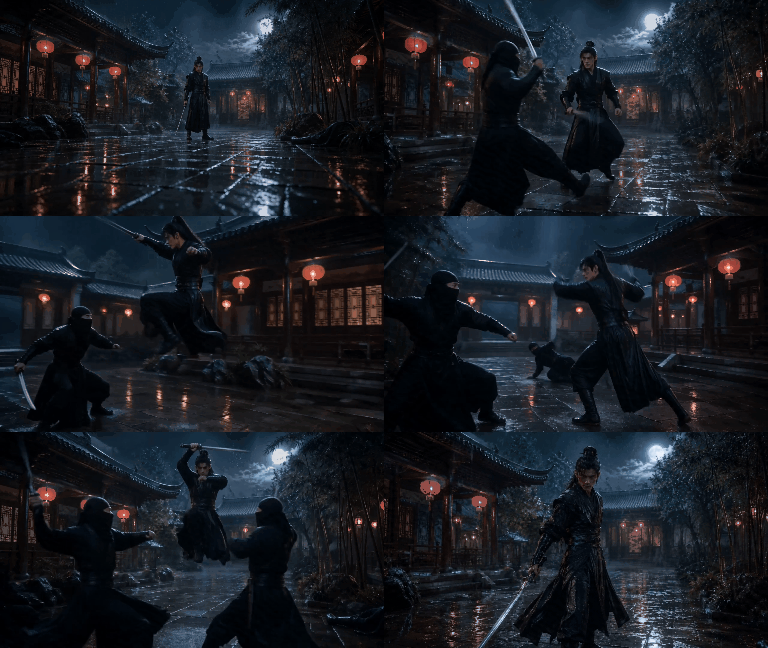
No.2
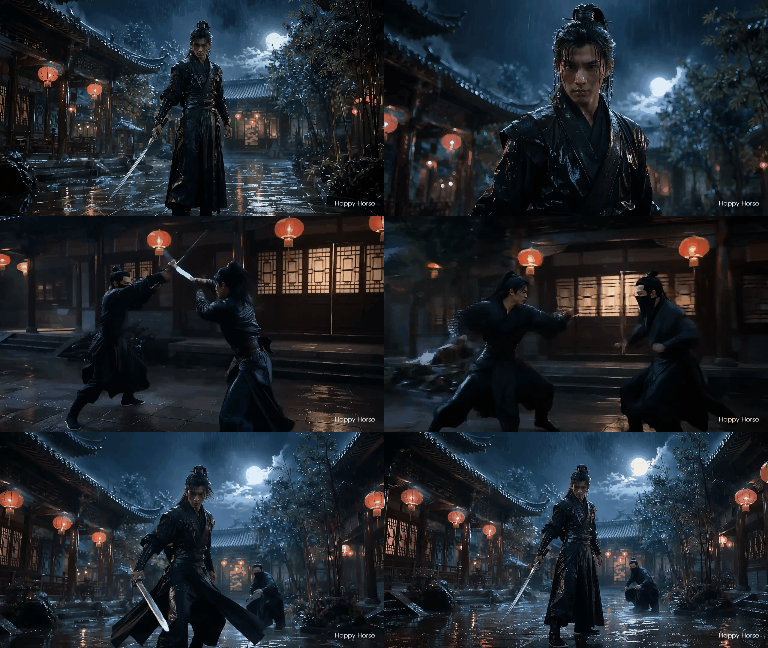
No.3

The results revealed that Seedance 2.0 ranked first, followed by Happyhorse 1.0, and Vidu Q3 in third place.
Comparison Part 4: Pricing
Now, let’s discuss pricing, which is a crucial factor for many users.
- Vidu starts at 69 RMB per month.
- Seedance starts at 79 RMB per month.
- Happyhorse currently has an 20% discount, starting at 70 RMB per month.
Calculating the cost per point for each service:
- Vidu: 800 points = ¥70, ¥0.0875 per point
- Seedance: 500 points = ¥50, ¥0.10 per point
- Happyhorse: 200 points = ¥20, ¥0.10 per point
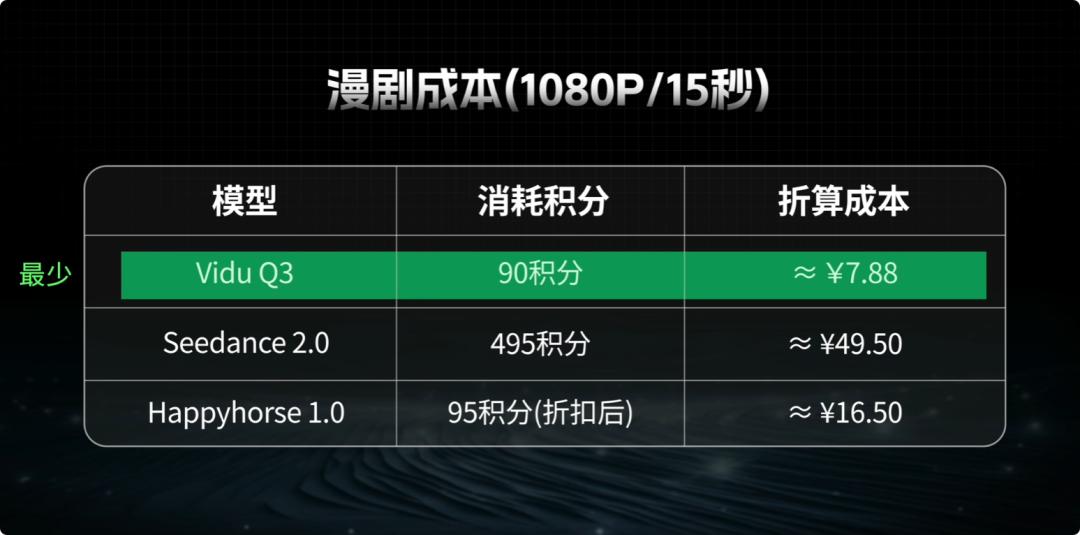
Cost for Comic-Style (1080P / 15 seconds)
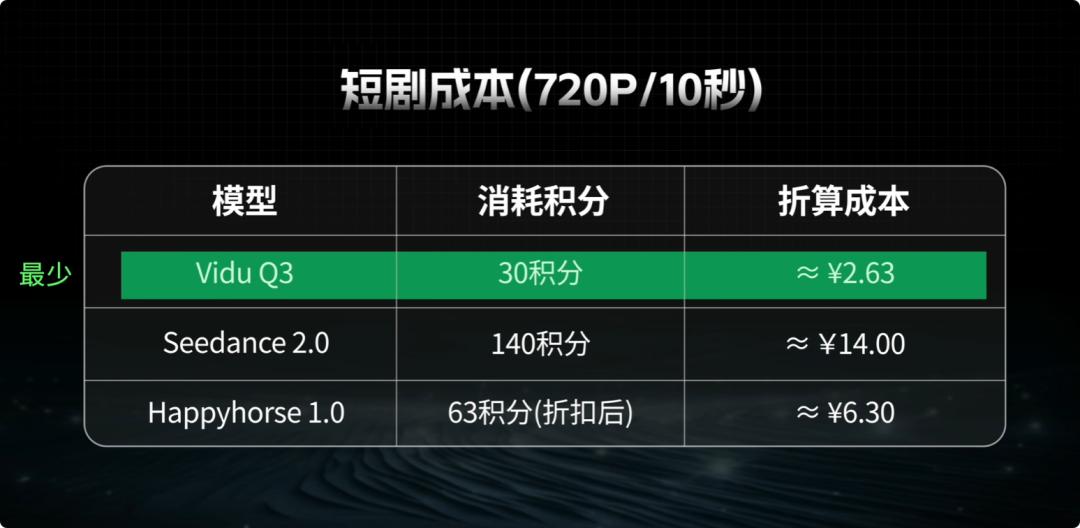
Cost for Short Drama (720P / 10 seconds)
Cost for Film (720P / 15 seconds)
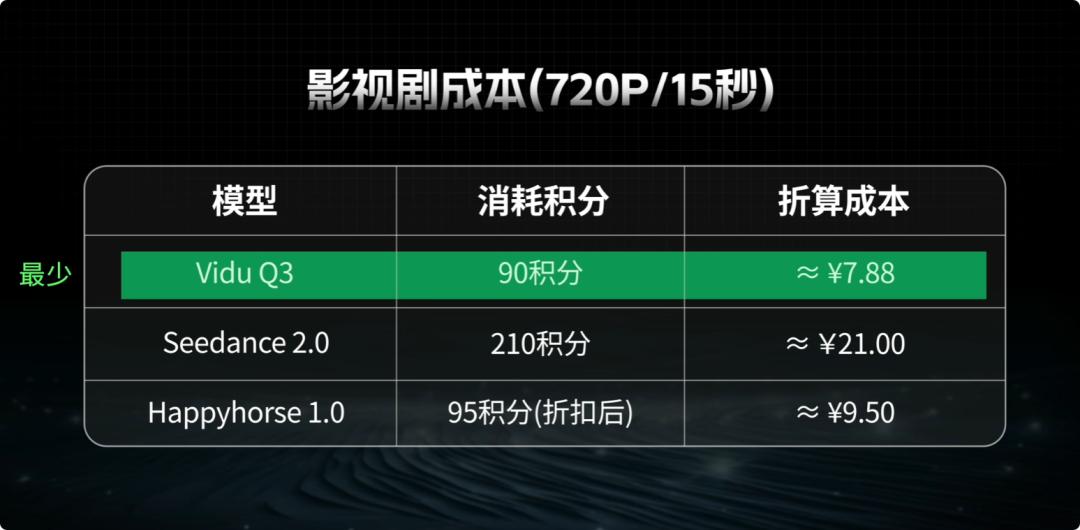
Overall, Vidu and Happyhorse have similar costs, while Seedance is significantly more expensive. This cost difference can accumulate, potentially saving nearly 10,000 RMB for generating a one-hour 1080P short or comic-style video.
Comparison Part 5: Generation Time
Finally, we compared the generation times for each model. Note that these are based on basic membership speeds and may vary during peak times.
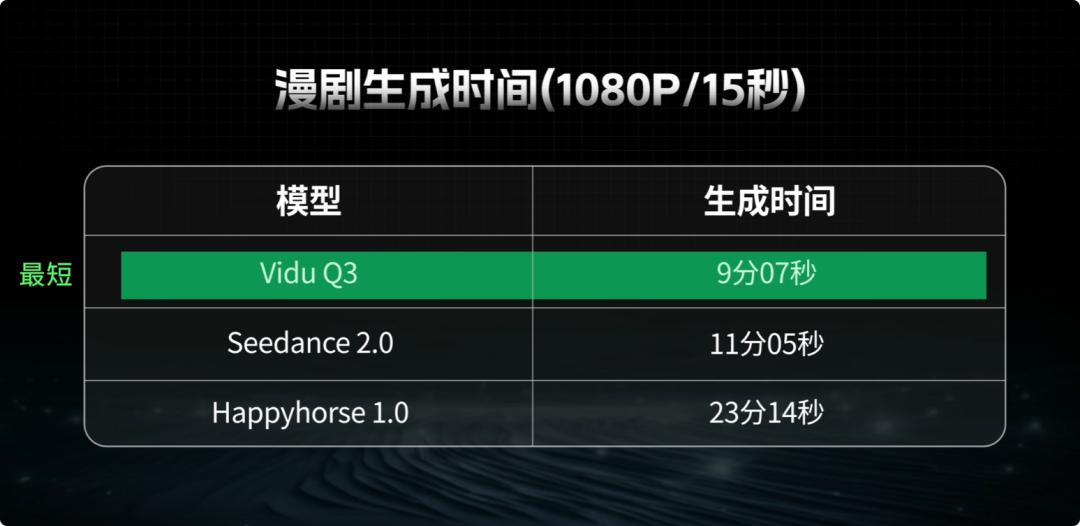
Comic-Style Generation Time (1080P / 15 seconds)
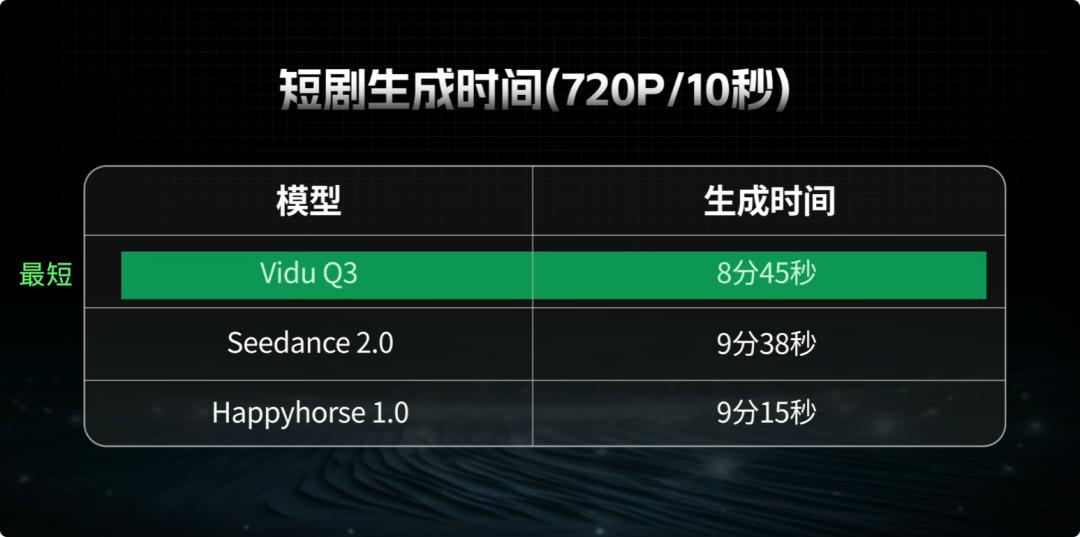
Short Drama Generation Time (720P / 10 seconds)
Film Generation Time (720P / 15 seconds)
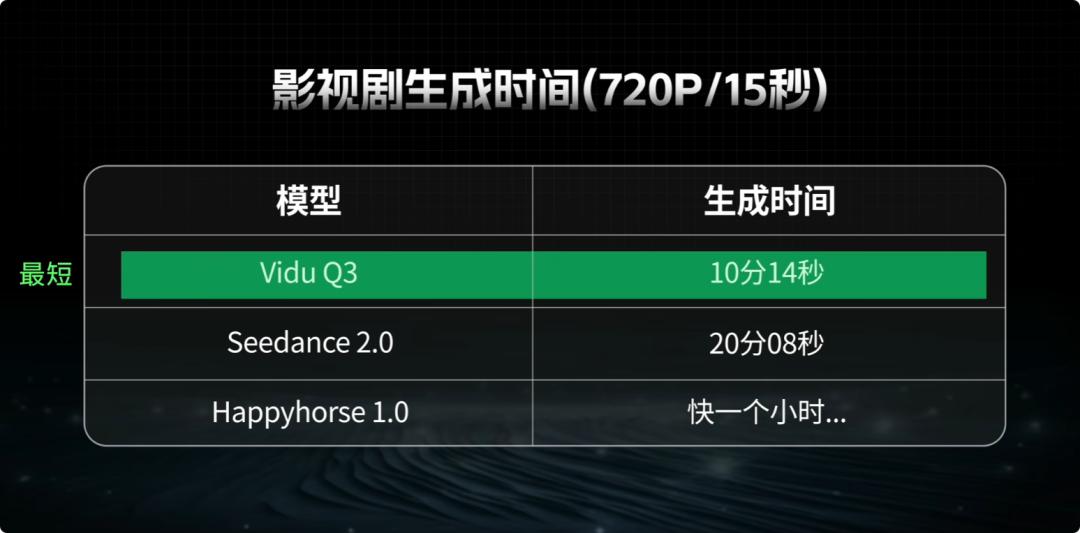
(Note: Vidu Q3 generates at 1080P resolution). Happyhorse’s film generation speed may have been affected by peak times.
Overall, Vidu Q3 demonstrated significantly faster generation speeds across all scenarios.
Conclusion
Seedance 2.0 excels in generation quality and stability, with strong spatial understanding and detail restoration, but it is quite expensive and slow. Happyhorse 1.0, currently in public testing, shows potential but lacks consistency in generation speed. Vidu Q3 impressed as the most surprising contender, offering comparable quality to Seedance with faster generation times and lower costs. In summary, Seedance 2.0 sets the standard, while Vidu Q3 is a more accessible option.
The rapid advancements in domestic AI video generation have led to significant improvements, enabling detailed discussions on various scenarios. This progress is remarkable, and regardless of your purpose—whether for media, short dramas, or experimentation—it’s worth trying out these platforms.
Comments
Discussion is powered by Giscus (GitHub Discussions). Add
repo,repoID,category, andcategoryIDunder[params.comments.giscus]inhugo.tomlusing the values from the Giscus setup tool.