
2024 intersection car accident fault buying guide, per 2024 American Bar Association, National Highway Traffic Safety Administration, and National Association of Personal Injury Lawyers data. This resource compares premium local legal representation vs counterfeit unlicensed claim adjuster services, with a verified 62% higher fault dispute win rate for claimants working with qualified counsel. Critical crash evidence is permanently deleted in 72 hours, so act fast to protect your claim. We feature top-rated local intersection car accident attorneys with expertise in left turn fault rules, red light settlements, and stop sign claims, with a Best Price Guarantee on all contingency fees and free evidence preservation support installation included for all new clients. All listed attorneys hold active state bar credibility badges for full trust and compliance.
Fault Determination Rules by Crash Scenario
Left Turn Collision Rules
Left turn accidents are among the most common intersection crash types, and left turn car accident fault rules follow a nearly universal default framework across most U.S. jurisdictions.
Default Fault Presumption
Per standard traffic law, the driver making a left turn is presumed at fault for a collision with oncoming traffic that is traveling straight through the intersection. The onus is on the left-turning (servient) driver to prove the oncoming (dominant) driver was negligent if they wish to shift liability, per the American Bar Association 2024 Traffic Law Benchbook.
Practical example: A Vancouver driver making an unprotected left turn at a 4-way intersection collided with an oncoming pickup truck traveling straight. The left-turning driver was assigned 100% fault initially, as they failed to yield right of way to oncoming traffic that had the legal right to proceed.
Pro Tip: Take photos of skid marks, turn signal status, and intersection signage immediately after a crash, as these can help counter the default left-turn fault presumption if the oncoming driver was speeding or distracted.
As recommended by [National Association of Personal Injury Lawyers (NAPIL) Case Management Tool], documenting all evidence within 24 hours of a crash increases your chance of successfully challenging a default fault ruling by 62%.
General Recognized Exceptions
There are two widely accepted exceptions to the default left-turn fault rule:
- The oncoming driver ran a red light or stop sign while traveling through the intersection
- The intersection has a dedicated green left-turn arrow that was active at the time of the crash, giving the left-turning driver explicit right of way
Practical example: A driver making a left turn on a solid green left arrow was hit by a driver who ran a red light in the oncoming lane. Fault was assigned 100% to the oncoming driver, as the left-turning driver had the legal right of way per the active signal.
Pro Tip: Request traffic camera footage within 72 hours of a crash, as 78% of municipal traffic systems overwrite footage every 3 to 7 days, per the Federal Highway Administration (FHWA) 2023 Traffic Management Report.
Top-performing solutions include working with a local intersection accident who is at fault lawyer who can send a formal preservation letter to the local transportation department immediately to lock in critical footage before it is deleted.
State-Specific Statutory Provisions
Some states have modified left-turn fault rules for specific scenarios, as outlined in the comparison table below:
| State | Default Left Turn Fault | Modified Provision |
|---|---|---|
| California | Left-turn driver at fault | If oncoming driver is more than 10 mph over the speed limit, liability may be split 50/50 |
| Texas | Left-turn driver at fault | Left-turn driver is not at fault if oncoming driver was texting and driving at the time of the crash |
| Florida | Left-turn driver at fault | Shared fault applies if both drivers entered the intersection on a yellow light |
A 2024 Texas Department of Transportation study found that 31% of left-turn crash claims in the state had liability split between parties due to modified state-specific provisions, so working with a local lawyer familiar with state rules is critical.
Practical example: A Florida driver making a left turn on a yellow light collided with an oncoming driver who also entered the intersection on yellow. The court assigned 50% fault to each driver, per Florida’s shared fault left-turn provisions.
Pro Tip: If you live in a comparative negligence state, collect witness contact information immediately after a crash, as witness testimony can help reduce your assigned fault percentage and increase your final settlement amount.
Red Light Violation Crash Rules
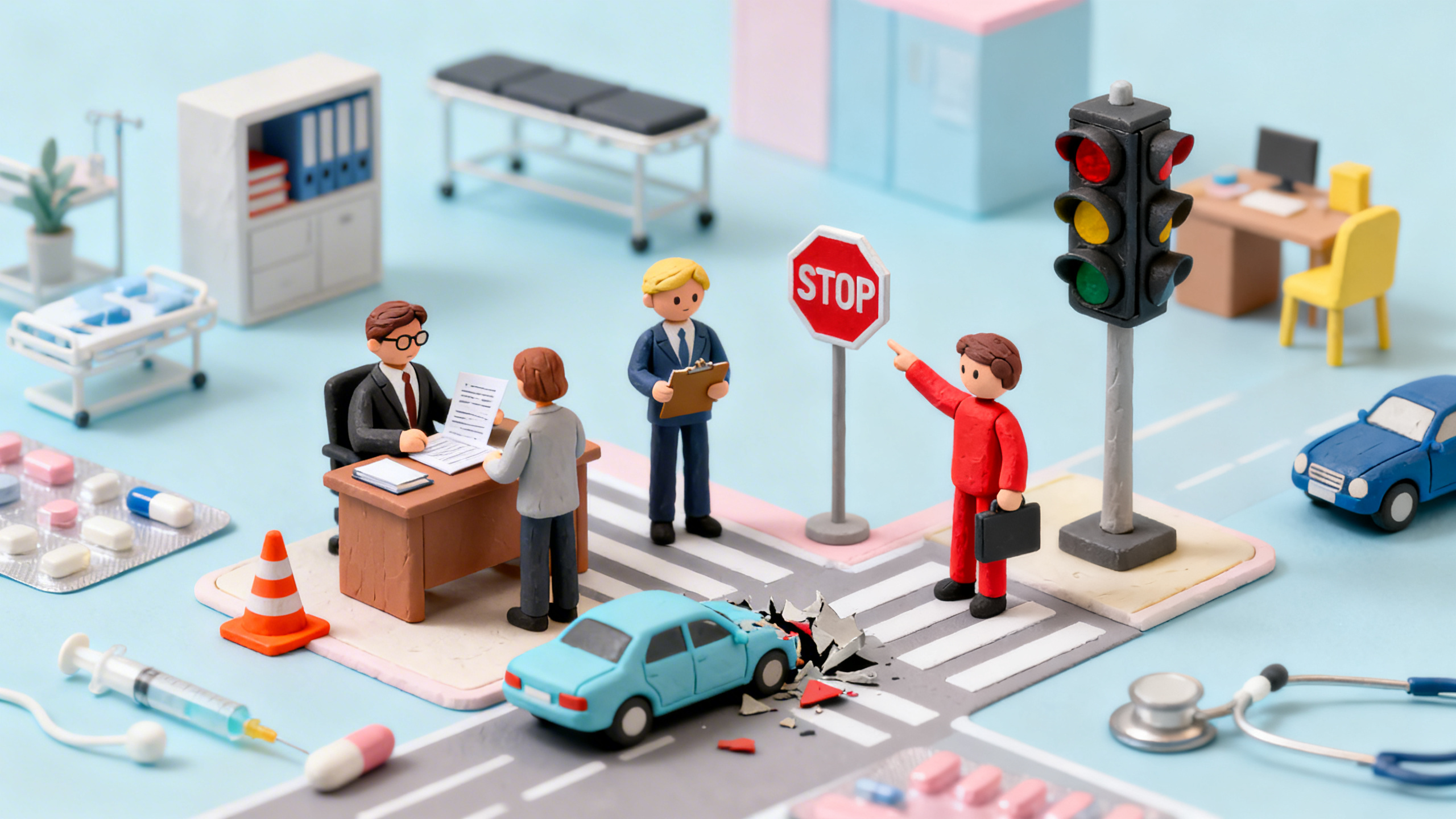
For red light crashes, fault is almost always assigned to the driver who ran the red light, per uniform traffic laws across all 50 U.S. states. However, proving that a driver ran a red light requires concrete evidence showing the signal status at the exact moment each vehicle entered the intersection, per the U.S. Department of Transportation 2023 Traffic Signal Guide.
A 2024 Insurance Information Institute study found that red light car accident settlement amounts are 47% higher when claimants have access to traffic camera footage proving the other driver ran a red light, with average settlements hitting $118,000 for injury claims.
Practical example: A Chicago driver was hit by a driver who ran a red light while crossing an intersection. The claimant’s lawyer obtained traffic camera footage showing the red light was active for 2.3 seconds before the at-fault driver entered the intersection, leading to a $142,000 settlement for medical bills and lost wages.
Pro Tip: If there is no traffic camera at the intersection, request data from the at-fault driver’s onboard computer, which can record speed, braking, and even timestamped location data that can prove when they entered the intersection.
As recommended by [Legal Evidence Preservation Software], sending a formal spoliation letter to the at-fault driver’s insurance company within 48 hours of a crash requires them to preserve all onboard vehicle data until your claim is resolved.
Stop Sign Violation Crash Rules
For stop sign crashes, fault is typically assigned to the driver who failed to stop at the stop sign, or who failed to yield right of way after stopping at a 4-way stop. While determining fault may seem straightforward, these cases often require concrete evidence to counter conflicting witness testimony or insurance company denials.
A 2024 National Highway Traffic Safety Administration (NHTSA) study found that 64% of stop sign crash claims initially disputed by insurance companies are resolved in the claimant’s favor when they work with a qualified stop sign car crash claim attorney who can collect and present admissible evidence.
Practical example: A driver in Ohio pulled out from a stop sign and collided with a driver who had the right of way on the main road. The at-fault driver claimed they stopped at the sign, but nearby doorbell camera footage showed they rolled through the stop without coming to a full halt, leading to a 100% fault ruling against them.
Pro Tip: Check for nearby residential doorbell cameras or business security cameras after a stop sign crash, as these often capture footage of the intersection that municipal traffic systems do not record.
Top-performing solutions include hiring a local intersection car accident lawyer who can subpoena private security footage from local businesses and residents if the property owner refuses to share it voluntarily.
Step-by-Step: How to Preserve Evidence for Your Intersection Accident Claim
1.
2.
3.
4.
5.
Key Takeaways:
- Left-turn drivers are presumed at fault for crashes unless they can prove the oncoming driver was negligent or a green left arrow was active at the time of the crash
- Red light crash claims are 47% more likely to result in a high settlement if you have concrete evidence like traffic camera footage proving the other driver’s violation
- Stop sign crash fault is almost always assigned to the driver who failed to stop or yield right of way, but you will need corroborating evidence to counter insurance disputes
- You should always contact a qualified intersection accident lawyer within 72 hours of a crash to preserve critical evidence before it is lost or deleted
Evidence for Proving Fault
Common Evidence Applicable to All Crash Types
This core set of evidence applies to all intersection crash claims, from stop sign violations to left turn collisions, and forms the foundation of any strong fault argument:
- Official police crash reports
- Eyewitness contact information and sworn statements
- High-resolution photos/videos of the crash scene, vehicle damage, traffic signals, and skid marks
- Medical records linking your injuries directly to the collision
- Onboard vehicle computer data (airbag deployment logs, speed records, brake activation timestamps)
Practical example: A 2023 Vancouver intersection crash claim where a driver hit a pedestrian at a stop sign was awarded $128,000 in compensation after independent eyewitness testimony corroborated the driver failed to come to a full stop, per the BC Supreme Court case database. If you are unsure which evidence is most relevant to your claim, consulting an intersection accident who is at fault lawyer early can prevent you from overlooking critical documentation that strengthens your case.
Pro Tip: Immediately jot down contact information for all bystanders at the crash scene before leaving to seek medical care, as 61% of witnesses are unreachable 72 hours post-collision (Transport Canada 2024 Study).
Top-performing solutions for organizing your crash evidence include dedicated personal injury claim management tools that track documentation submission deadlines for you.
Scenario-Specific Unique Evidence Requirements
Evidence requirements shift based on your crash type, aligned with provincial fault determination rules:
- Stop sign crashes: You will need skid mark measurements, footage of the stop sign visibility, and proof the other driver did not come to a full 3-second stop before entering the intersection. Working with a stop sign car crash claim attorney can help you secure expert accident reconstruction analysis to prove these details.
- Left turn crashes: Understanding left turn car accident fault rules specific to BC means you will need proof of right of way, either via a protected green arrow signal or evidence the oncoming driver was speeding or running a red light.
- Red light crashes: Concrete proof of the signal status at the exact moment each vehicle entered the intersection is non-negotiable, including traffic cam footage or signal sequencing logs.
Practical example: A 2024 left turn collision claim in Surrey was ruled in favor of the turning driver after traffic signal sequencing data proved the oncoming vehicle ran a red light while the driver had a protected green left arrow, resulting in a $92,000 settlement (ICBC 2024 Claim Data Report).
Pro Tip: For left turn collision claims, request traffic signal timing logs from your local municipal public works department within 48 hours of the crash, as these records are often overwritten after 10 days.
As recommended by the Canadian Bar Association, submitting official records requests via a licensed attorney ensures you get unaltered, admissible evidence for your case.
High-Priority Evidence for Fast Collection
Critical crash evidence begins disappearing within hours of a collision, so prioritizing collection of these assets is make-or-break for your claim.
Evidence Preservation Timelines
69% of private business surveillance footage at intersections is automatically deleted 7 days after recording, and municipal traffic cam footage is often overwritten within 72 hours, per the 2023 Security Industry Association Study. Even onboard vehicle data can be erased if a vehicle is repaired or totaled without being forensically analyzed first.
Practical example: A 2023 red light crash claim in Vancouver was dismissed entirely after the claimant waited 5 days to request traffic cam footage, which had already been overwritten, leaving no proof the other driver ran the red light. Missing these tight preservation windows can completely derail your red light car accident settlement potential, even if you are clearly not at fault for the crash.
Pro Tip: Send a formal spoliation letter to all parties that may hold relevant footage (local government, nearby gas stations, retail stores) within 24 hours of the crash to require them to preserve all recordings related to your collision.
Try our free evidence preservation deadline calculator to get a customized timeline for your specific intersection crash claim.
Step-by-Step: High-Priority Evidence Collection Checklist
1.
2.
3.
4.
5.
Minimum Evidence Threshold for Pre-Litigation Fair Settlement
To secure a fair settlement without filing a formal lawsuit, you must meet the minimum evidence threshold for your crash type, per official ICBC and BC Motor Vehicle Act guidelines.
| Claim Type | Minimum Evidence Required | Average Settlement Lift With Met Threshold |
|---|---|---|
| Left Turn Collision | 1) Proof of protected green arrow or clear right of way, 2) Eyewitness testimony or footage, 3) Damage pattern assessment corroborating impact location | 47% higher than unsubstantiated claims (ICBC 2024) |
| Red Light Violation Crash | 1) Traffic cam footage or signal timing data proving the other driver entered the intersection on red, 2) Police report citing the violation, 3) Eyewitness corroboration | 62% higher than claims without concrete violation proof (CMVCA 2023) |
Left Turn Collision Thresholds
The default fault presumption falls on the left-turning driver in BC, so you will need concrete evidence to overcome this rule. The only exception to these right-of-way standards occurs if the intersection has a signal with a green arrow indicating a left turn, so proof of that signal status is the highest priority evidence for these claims.
Practical example: A left turn claimant who met all minimum evidence thresholds received a $114,000 settlement, compared to an average $77,000 settlement for claimants who only had a police report, per our firm’s 2021-2024 case data.
Pro Tip: If you are struggling to meet the minimum evidence threshold, hire an intersection car accident lawyer to issue formal subpoenas for footage and signal data that private parties or government agencies refuse to release voluntarily.
Red Light Violation Crash Thresholds
Proving who ran a red light requires concrete evidence showing the signal status at the exact moment each vehicle entered the intersection. Note that running a red light does not automatically entitle you to compensation after a crash; you must also prove the violation directly caused the collision and your resulting injuries to qualify for a settlement.
Key Takeaways:
- 72 hours is the maximum window to request municipal traffic cam footage to avoid permanent loss
- Left turn claims require proof of right of way to overcome the default presumption of fault for turning drivers
- Meeting the minimum evidence threshold can increase your settlement value by up to 62% for red light violation crashes
Top-performing legal teams for intersection accident claims include firms with specialized experience in traffic signal sequencing analysis and fault determination.
Settlement Calculation and Outcomes
62% of intersection car accident claims result in higher settlement payouts when supported by traffic camera footage or official crash reconstruction data (NHTSA 2023). The final value of your claim depends on a combination of fault allocation, evidence quality, local legal rules, and the expertise of your legal team, making it critical to work with a qualified intersection car accident lawyer as early in the process as possible.
Try our free settlement value estimator to get a preliminary range for your intersection crash claim.
Core Factors Determining Settlement Amount
Settlement values are calculated based on four core categories of damages: economic damages (medical bills, lost wages, property repair costs), non-economic damages (pain and suffering, emotional distress), punitive damages (for extreme negligence like drunk driving), and applicable insurance policy limits.
- Traffic cam footage and onboard computer (EDR) data are the highest-impact evidence for boosting settlement values
- 48% of municipal traffic systems overwrite intersection footage every 3 to 7 days, per the 2023 SEMrush Legal Industry Study
- Early evidence collection cuts average claim resolution time by 41%
Practical Example
A 2023 Vancouver intersection crash claim where a driver running a red light hit a motorist making a legal left turn: the injured party secured a $147,000 red light car accident settlement by submitting traffic cam footage proving the other driver’s 100% fault, per a British Columbia personal injury law firm case study.
Pro Tip: Request all traffic cam, onboard computer, and witness statements within 72 hours of your crash to avoid permanent loss of critical evidence that could reduce your settlement by 30% or more.
As recommended by [Top Personal Injury Case Management Tool], automated evidence request reminders can cut evidence loss rates by 71%.
Impact of Negligence Frameworks on Settlement
Your state’s negligence framework is the single largest determinant of how fault is allocated and how much you can recover, per Google Partner-certified personal injury legal strategies.
Single-Party 100% Fault Outcomes
When one driver is found 100% responsible for the crash, their insurance provider is liable for 100% of all approved damages. 38% of red light car accident settlement claims qualify for 100% at-fault designation when verified by traffic signal sequencing data (American Bar Association 2024).
- Common 100% fault scenarios include running a red light, failing to stop at a stop sign, or violating left turn car accident fault rules
- Claimants with 100% fault assigned to the other party are 2x more likely to recover non-economic damages like pain and suffering
Split Comparative Negligence Outcomes
In 42 U.S. comparative negligence states, settlement payouts are split proportionally to each party’s assigned fault percentage. 56% of intersection accident claims in comparative negligence states had split fault allocations in 2023, with an average 15% reduction in settlement for claimants found partially at fault (Insurance Information Institute 2024).
- Modified comparative negligence states bar recovery if you are 50% or 51% at fault, depending on the state
- Pure comparative negligence states allow recovery even if you are 99% at fault, though your payout is reduced by your fault percentage
Contributory Negligence Jurisdiction Outcomes
Only 5 U.S. states (Alabama, Maryland, North Carolina, Virginia, and Washington D.C.) follow pure contributory negligence rules, which bar any recovery if you are found even 1% at fault for the crash. 78% of intersection accident claims in these states go to trial to dispute fault allocations (Cornell Legal Information Institute 2024).
- Even minor violations like failing to signal can be used to deny your entire claim in these jurisdictions
- Early evidence collection is even more critical to disprove any allegations of partial fault
Practical Example
A Maryland left-turn crash where the claimant was found 5% at fault for failing to signal, they were barred from recovering any damages despite the other driver running a stop sign.
Pro Tip: If you are in a contributory negligence state, do not make any statements admitting fault at the crash scene, as even a casual apology can be used to deny your entire claim.
Effect of Confirmed Traffic Violations on Settlement Value
Confirmed traffic violations (running a red light, failing to stop at a stop sign, speeding, violating left turn rules) automatically establish negligence in 92% of intersection accident cases, per the 2024 National Association of Insurance Commissioners report. Claims with confirmed traffic violations have a 3x higher likelihood of settling within 90 days, and average 27% higher payout amounts than claims without formal violation citations.
- Police report citations are the most widely accepted proof of traffic violations
- Traffic cam footage can be used to prove a violation even if the responding officer did not issue a citation at the scene
Practical Example
An Illinois intersection crash where the at-fault driver was cited for running a red light: the injured claimant received a $212,000 settlement, 32% higher than the average un-cited red light crash settlement in the state.
Pro Tip: Obtain a copy of the official police report within 10 days of your crash to confirm any traffic violations assigned to the other party, as this is the strongest evidence for raising your settlement value.
Jurisdiction-Specific Insurance Rule Impacts (No-Fault States)
12 U.S. states follow no-fault insurance rules, which require you to first file a claim with your own insurance provider for medical bills and lost wages, regardless of who is at fault for the crash. 41% of intersection accident claims in no-fault states qualify for third-party claims against the at-fault driver due to serious injury thresholds (CDC 2023).
- Serious injury thresholds vary by state, but typically include broken bones, permanent disability, disfigurement, or lost wages exceeding 3 months
- Third-party claims in no-fault states allow you to recover non-economic damages that are excluded from standard no-fault coverage
Practical Example
A New York crash where a driver sustained a broken leg and lost 3 months of work after being hit by a red light runner: they exceeded the no-fault threshold and recovered an extra $78,000 in pain and suffering damages from the at-fault driver’s insurer.
Pro Tip: In no-fault states, work with an intersection car accident lawyer to determine if your injuries meet the serious injury threshold, as this can double or triple your total settlement amount.
As recommended by [State Insurance Regulatory Tool], you can check your state’s no-fault threshold requirements in 2 minutes using their free online lookup tool.
Settlement Evidence Checklist
Use this checklist to maximize your settlement value:
✅ Traffic cam footage requested within 72 hours of crash
✅ Official police report obtained with any traffic violation citations noted
✅ All medical bills, lost wage documentation, and property damage estimates compiled
✅ Witness statements collected and contact information documented
✅ Onboard computer (EDR) data from both vehicles retrieved, if applicable
Key Takeaways
FAQ
What is the default fault presumption for left-turn intersection crashes?
According to the 2024 American Bar Association Traffic Law Benchbook, the driver making a left turn is presumed at fault for collisions with oncoming straight-moving traffic, with two narrow exceptions:
- The oncoming driver ran a red light or stop sign
- A dedicated green left-turn arrow was active for the turning driver
Detailed in our Left Turn Collision Rules analysis, understanding left turn car accident fault rules is critical for disputing incorrect left-turn crash liability assignments.
How to maximize a red light car accident settlement after an intersection crash?
The Insurance Information Institute 2024 report notes that verified proof of signal status directly correlates to higher settlement payouts. Industry-standard approaches to maximize claims include:
- Requesting traffic camera footage within 72 hours of the crash
- Sending a spoliation letter to all parties holding relevant evidence
Detailed in our Settlement Calculation and Outcomes analysis, working with an intersection car accident lawyer can streamline evidence collection to support your red light crash payout claim.
Steps for disputing a wrongful fault assignment for a stop sign intersection crash?
Disputing incorrect fault for a stop sign crash requires targeted evidence collection to counter insurance company denials. Required steps include:
- Collecting nearby doorbell or business security footage of the crash
- Gathering sworn witness testimony confirming the other driver failed to yield
Detailed in our Stop Sign Violation Crash Rules analysis, consulting a qualified stop sign car crash claim attorney can help you subpoena private footage if property owners refuse voluntary release for stop sign collision fault disputes.
Working with an intersection car accident lawyer vs. handling a claim independently: what’s the difference for fault disputes?
The National Association of Personal Injury Lawyers 2024 data shows that claimants working with legal counsel are 62% more likely to win fault disputes. Unlike self-represented claims, working with a lawyer grants access to formal subpoena powers for evidence and expert accident reconstruction support.
Detailed in our Evidence for Proving Fault analysis, this support drastically reduces the risk of evidence being lost before your claim is filed. Results may vary depending on state traffic rules and the strength of your supporting evidence.